 |
 |
 |
|||||
|
Origins of Hui Kū Maoli Ola:
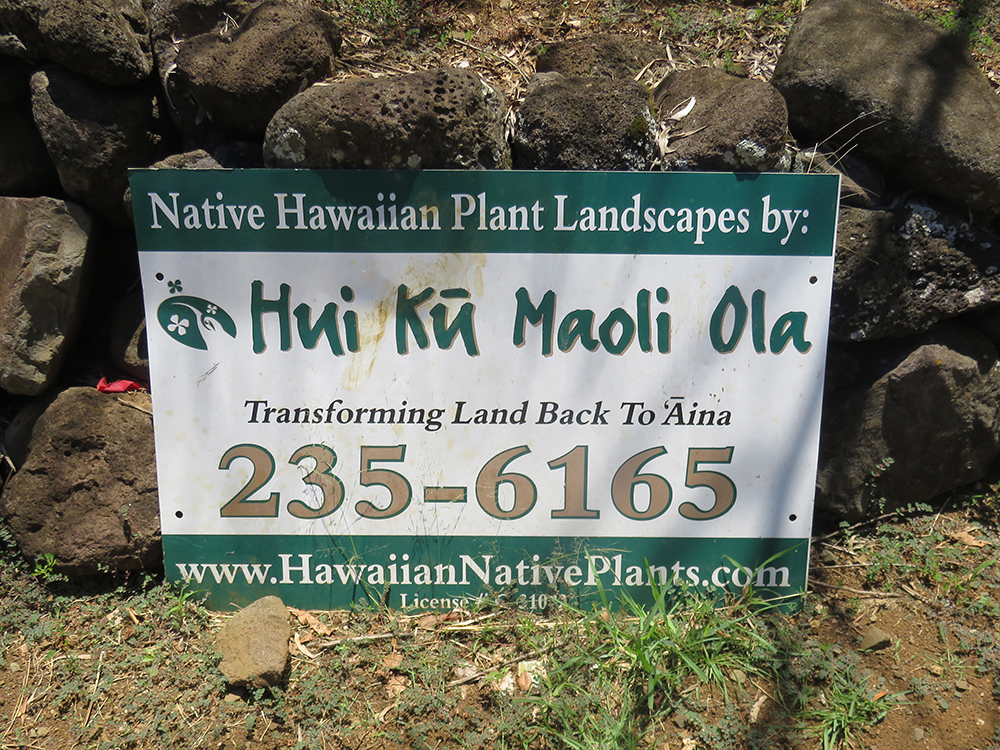
“Ever since I was a kid, I loved the ocean,” Rick says. “I actually consider myself more of an ocean guy than a plant guy. I love fishing. I just hated not catching fish. And then you read about how abundant things were, and you look at other places in the Pacific that look like Hawaii that are just overflowing with fish. And it’s like, ‘Okay, why aren’t we like that?’ “That kind of sparked my interest. I actually started taking marine biology classes at UH while I was in high school and became an instructor through a program called Blue Autumn Marine Lab while I was in high school, and we would actually teach other high school students. We actually worked on a boat and we taught various aspects of learning biology or navigation and everything, from elementary school students all the way to college graduates. “When I got into UH after I graduated high school, I really wanted to be in the ocean component somehow. And then one day, in an elective, I took ornithology class. We started learning about birds of Hawai‘i, and we took a trip to Hakalau Rainforest on the Big Island and saw my first native forest birds. “We actually mist-netted some birds, took samples, caught a Hawaiian hawk. I mean, I was blown away. And I always knew I wanted to grow something, so even when I was in the marine biology side of it, I figured I was going to go into some sort of aquaculture, some sort of development that allowed people to access the fish. And then when I got into the native birds, I was like, ‘Oh man, I really want to grow, provide birds.’ “But I knew that was way out of my capacity, especially as an undergrad. And so, I figured, ‘Ah, what’s the next best thing that I could do?’ would be to provide habitat for the birds. And when I go home, I look at my yard and there’s absolutely nothing in my yard that would provide some sort of sustenance or even an ideal house for some of these native forest birds. “I knew it was a long shot being how rare most of our native forest birds are, but I figured, ‘ah, I might as well try at least,’ you know? And so, I started to learn about native plants. And from that, I started to realize that everything that I thought was Hawaiian wasn’t Hawaiian. That just kind of blew my mind, and I was actually upset that, if I’m thinking this, everybody is thinking this. “And if everybody is thinking this, they’re just blind to the fact... They’re apathetically blind in the sense that they don’t even know that they’re not helping, or they actually think that they are helping but they are doing the opposite. And in most cases, people are planting plants that are invasive and hurting our ecosystems, but thinking that they’re doing a good thing. “I wanted to change that, and I started with my own parent’s yard at the time. I was still pretty young. And it was funny, because my parents would actually go on trips. And whenever they would go on trips, I would cut down one of their trees or plants in their yard, and I would replace it with something native. And that’s when, at the same time, there weren’t any nurseries in Hawai‘i growing native plants. So I started learning about which plants are native, and which plants are Polynesian-introduced, and which plants are invasive. “Growing up in Waimānalo, it’s like nursery capital of O‘ahu, plant nursery capital. So me and my business partner Matt Schirman, Kapalikū Schirman, he’s also a co-founder of Papahana too with Keoni. We would go throughout Waimānalo and go to every nursery, and they wouldn’t have anything. And so, we would read these books, go hiking, see these plants in the wild, collect a few seeds here and there. “Luckily enough, his dad, they lived on like an acre of land in Waimānalo, and the dad had a little tiny greenhouse. Like literally, the size of this table; super small, like just this little thing. And we started putting these seeds in there, and they started growing, and we started reading more books and learning new ways to propagate plants, all while we’re still in college and we hadn’t graduated yet. “The only place you could really buy native plants were at the botanical garden plant sales. So whenever Lyon Arborteum would have a plant sale or Foster’s Botanical Garden would have a plant sale, we would stand in line like early in the morning because now, there was this buzz above native plants going on. And if you weren’t one of the first 25-50 people in line, you weren’t going to get a native plant. “Sometimes, the lines were like 400 people long before it would open up. It was crazy. And so, we would always have this plan where we would go and... And most of the times, they would have all these native plants separated out from all of the other plants in the sale, so we would rush in there and just grab one of everything that we could see that was different. “And then we would bring them back on the side, and we would pick through them. And if we ever had doubles, then we would put them back. Because we were on a very limited budget, and back then... Like for example, a plant that we sell on our nursery today for two dollars, back then it was 20 dollars. Being in college, you don’t have money, so plants that... Whatever we would get from these plant sales, half of it would come with me, the other half would go with him, he would plant in his house, I’ll plant at my house, and we would nurture them. “And then whatever he didn’t have, we would propagate so that he could have it, whatever I didn’t have and vice versa. And so by doing that, we learned how to propagate the native plants. And then too, by putting them in the ground and caring for them, we understood what it took for them to survive in people’s yards. “It kind of annoyingly gave us an advantage of all of these plants that now we started to grow. And then before we knew it, we took a table that had this much, could fit this many plants, and we convinced the neighbor to use part of their land, and we had like a quarter-acre of tables. And his dad was a contractor, and he did this demo of this pool deck that was made out of redwood, and the wood was still really good. I think we made like 30 tables that were 15 feet long by 4 feet wide. “Within two years, we had everything filled. We had all of these plants, but we didn’t have a means of selling them. And so, we saw how... We’re still in college and we haven’t graduated yet, and when we actually held our first plant sale at UH, and we invited other backyard growers that we know of at the time, and I think we probably had about six vendors and it was just all native plants. “We sold everything that we brought to the sale. And so, we were like, ‘Right on!’ That just encouraged us to grow more. And then to make money, outside of that, at night I was a sushi chef in Waikīkī, and I was actually a sushi chef throughout all of college. It paid for college and everything. This is kind of the breaking point as to what made us take it to the next level. Before, it was just a hobby. “Then one night, while I was at the sushi bar, these two guys came down, sat at the table, and we started talking. And one of the gentlemen was pretty old and the other guy was pretty young. The young guy was talking to me and wanted to know where all the cool places were to hang out. This is actually the time when The Real World on MTV, that show, was being filmed in Hawai‘i, and that one Hawai‘i episode, it was pretty early back then. And he wanted to know where all those places were, and being that we’re in Waikīkī, the restaurant was in Waikīkī, it was pretty close to where they were living, and the places that they were going. “He and I struck the conversation at the end, he’s like, ‘Oh, is this all you do? You just make sushi?’ And I was like, ‘Nah, actually, I’m a full-time student. I’m graduating in a couple of months. And on the weekend, me and my friend, we have this native plant nursery and we grow all of these rare Hawaiian plants.’ And he was like, ‘Really?’ And I’m like, ‘Yeah.’ And he’s like, ‘You interested in selling any of your plants?’ And I’m thinking, ‘Ah, is this guy from Ohio or whatever wants to take some plants home with him.’ I’m like, ‘Yeah, we’re always interested in selling our plants.’ “And he’s like, ‘Can you produce a lot?’ And I’m like, ‘Yeah, of course we can.’ But really, it was just me and Matt. And we had just sold out of everything that we had in the nursery. And then he gives me his card, and he’s like, ‘Oh,’ And I still have his card. ‘My name is Jason Feldman.’ And he’s like, ‘I’m an Executive Buyer for the Home Depot. If you guys ever want to sell your plants through the Home Depot, let them know that I sent you.’ “And I’m like, ‘That sounds great, but what’s the Home Depot?’ Because we never had one yet in Hawai‘i. He was there with that other gentleman building the first Home Depot. I had no idea what the hell Home Depot was. So it actually took us a couple of weeks because we were so busy doing schoolwork and everything. And then finally, I’m like, ‘Hey, let’s go check out this place. It’s supposed to be this Home Depot place.’ “We just took a drive-by. We went there, like, ‘Oh my god, this place is humongous.’ We looked at their nursery, we were like, ‘What!?’ And so, we pulled in, and we asked to speak to the garden manager. And the garden manager was expecting us to come because that guy had told them to be on the lookout for us. “So then we had to get our G license. We had to register our company and we had to do all of the legitimate stuff. And then we got their vendor application and we were like, ‘Oh my god, we don’t have anything.’ So we had to get our insurance, we had to deal with all of these things, jump through all of these hoops in order to sell our plants at Home Depot. “Before that, we had made a commitment to ourselves, ‘Okay, if we’re going to go this route, we got to go full bore.’ And I was already going to go to grad school. I was set to get into grad school. Matt was in his first year of grad school. And so, I was like, ‘Okay, once I graduate, then we will dedicate one year to this.’ And if it works out, we’ll continue with it. If it doesn’t work out, we’ll go back to grad school.’ “Needless to say, that was 17 years ago and I have never been back to school, so it worked out pretty well. That was just the nursery. And then from the nursery side of it, we saw the demand for native plants growing, and then we saw them being used in the wrong manner. So that’s kind of what prompted us to start an education side of it. But for years, we were taking in school groups, taking in, coming into the organizations, taking in anybody that wanted to learn about native plants and not charging them. “It got to a point where it was so overwhelming that it started to take away from our production. And at that point, we committed to starting Papahana Kuaola to take over the educational side of it. Which is great, because their teaching feeds back into the business side. Because the more people that are aware and understand the importance of native plants, the better it is for business. More customers, right. “But still, on the actual commercial side of it, people were misusing the plants, putting the plants in the wrong place. And then when these plants were dying, everybody was like, ‘Oh, native plants are so hard to take care of.’ But it’s really not the plant’s fault, it’s like you’re planting a cactus in a pond.” Continue to the Waimānalo Stream Restoration story |
|
|||||
|
|||||
