 |
 |
 |
|||||
|
Waimānalo Stream Restoration:
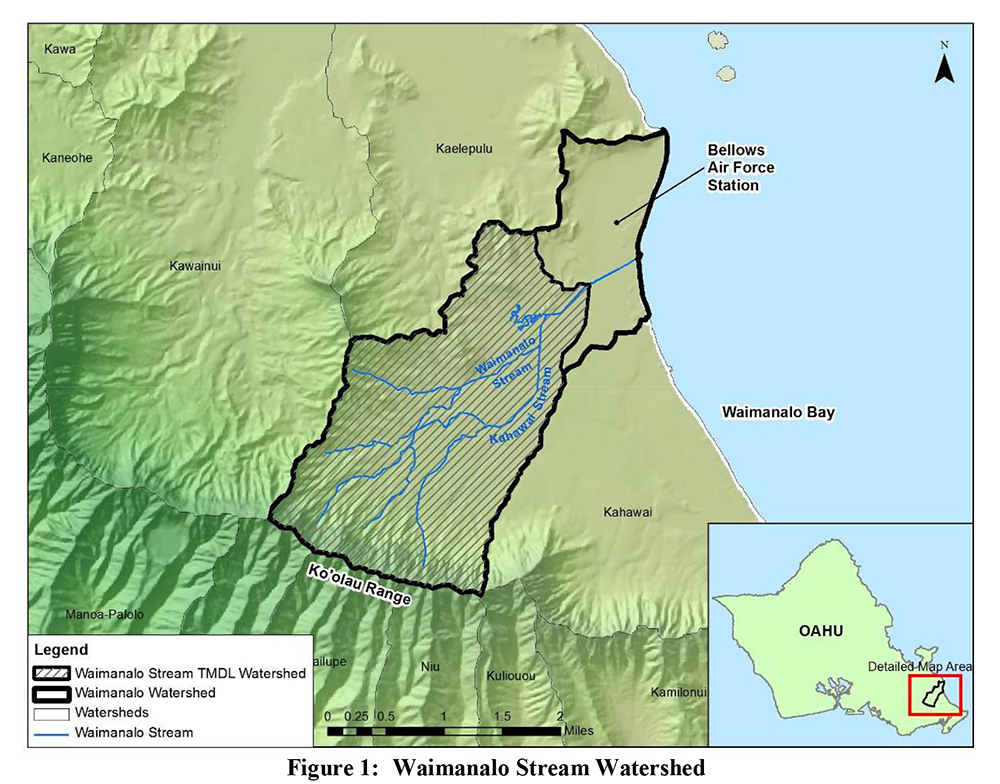
Rick picks up the story from the Origins of Hui Kū Maoli Ola: “The opportunity arose to be a part of a community effort to restore a stream in Waimānalo. We were totally excited about that because growing up in Waimānalo, the areas that this community organization wanted to restore was a part of the stream that, as a kid, you would never go in that stream because it was so gross. And unfortunately, being from Waimānalo, Waimānalo literally translates to ‘potable water,’ drinkable water. “It was embarrassing that we had these streams, and these estuaries, and these areas that were so polluted. It would even affect out into the ocean. So, growing up surfing all along Bellows and Sherwood and stuff like that, every summer or every super-sunny-sunny day in the winter, we would have these algae blooms that would turn the water surface fluorescent green. And it would make the foam in the surf really gross looking. All of this nutrient-rich water would go into the ocean, and it would cause the phytoplankton to just explode, especially on really sunny days. “All the nitrates and phosphates from the nurseries, the agriculture, the ranches and whatever back there. It’s unfortunate that all of these areas are positioned in the wettest part of the watershed. So all of that water leaches through the pots, picks up the nutrients, leaches through the stables where the horses are. All that water runs down into all of these little tributaries that feed into Waimānalo stream. And it makes it completely uninhabitable for native species, but preferable for invasive species. “One of the things is that prior to us starting our restoration work, there was an independent company that came in to do the water sampling, to test how polluted the water was. And on one of the days that they came down, they tested the levels of nitrates and phosphates to a point where the words that came out of his mouth was, ‘This section of the stream is 10,000 times more polluted than polluted.’ So basically, you reach a baseline as to where now you consider that water being polluted. That number times 10,000 as far as the amount of nitrates and phosphates. “Our section of the stream that we had done the restoration on, when we first did it, it was only about maybe 400 feet the first year. And then we did it to a point where it was close to 1800 linear feet of stream.
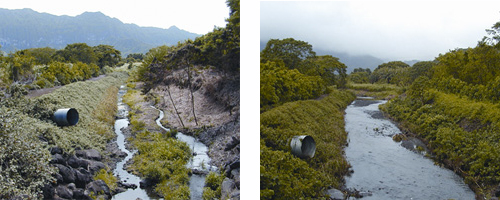
“And even this section of stream that we were working on wasn’t a natural formation. It was a channelized section of the stream that was done during the sugarcane plantation days. All of the lowlands of Waimānalo at one point were pretty much all sugarcane. That right there did the damage too. And the streams were channelized, wetlands were filled in. Where there’s Olomana Golf Course right now, that’s pretty much a wetland. And then they complain why it floods whenever it rains a lot. “All of these things that were meant to control erosion and control nutrient-loading from going out into the ocean is now just a highway, autobahn, straight out into the ocean, which is causing all of these problems. 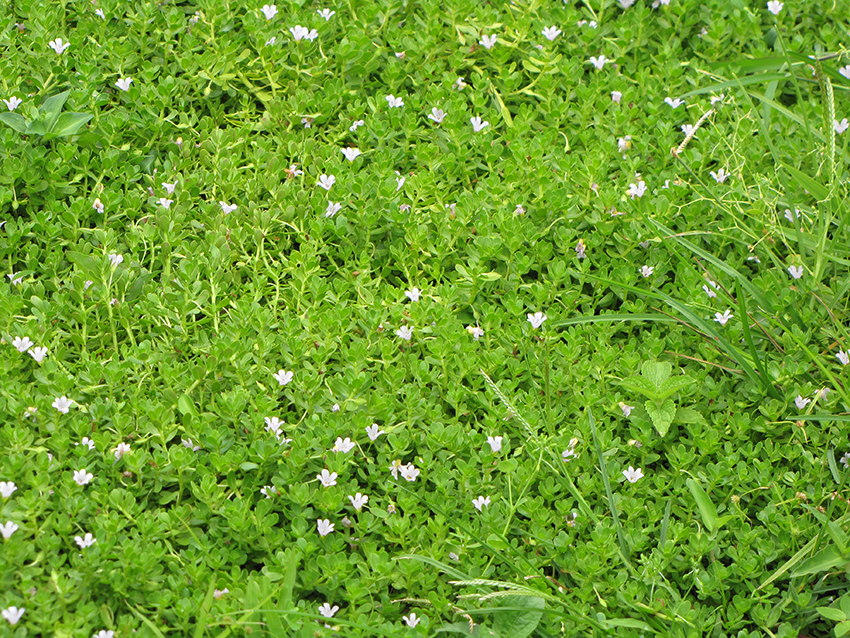
“Actually, when we started our restoration, we found a couple of native plants within the stream channel that we took material from to propagate. And in this one plant which in Hawaiian is called ‘ae‘ae, the botanical name is Bacopa monnieri [water hyssop], It’s a pretty widespread ground cover. It was growing in the water channel, and then we encouraged it to grow and just tried to weed around it and let it spread. “Eventually, it took up the entire stream channel as a ground cover, and the water passed through it. And at that point, once we did the 400 feet, there was two endangered wetland birds that came down. They’re called ‘alae ‘ula in Hawaiian. It’s a mudhen or moorhen. And they started just hanging out in the area. And the more that we expanded, they actually ended up having a brood, and they made a nest; they had hatchlings that came out. We started the project in, I believe, 2000. And by 2004, there was 17 of them we counted, so from 0 to 17 endangered birds within this area. “Not only that, there was so much tall vegetation in the water before that you couldn’t even see the water regardless of the channel itself. It’d just look like one flat growth of Job’s Tear plants. And then once we got it down, then you could actually see the channel. I actually had some before and after pictures, it’s pretty alarming, but now that we had the water flow and the water was flowing good—it wasn’t slow, stagnant, anaerobic water, it was actually flowing with a lot of oxygen—we saw huge recruitment by 2004 of native gobies, freshwater gobies: our only freshwater fish in Hawai‘i, o‘opu. We saw two of them, two different species. “But on one day in a 30-foot length, I counted 400 babies coming up. So it was really good to see that. It’s kind of like the movie, right? If you build it, they will come, and that’s totally what we did. We didn’t build it. We just restored it. It was always there. It always had the potential, and at one point it was doing it and it’s just through neglect and mismanagement it went down the tubes. “Back to water quality: once we got all of that area restored, the same guys came back and they did a sampling at the bottom of our project, and the water was clean. It wasn’t even remotely close to being polluted. And so, for us, that was such a huge thing, but it took three years to get to that point. But still, three years. Now the water that’s going out into the ocean is clean because there is no other additional inputs or pollution going into it further down from where we were. “And then we moved here. This is the sad part of the story. So we moved here even though the grant money was up for that project, we felt committed to taking care of that stream. And so, every four to six months depending on if there was a big rain event or something, we would take our entire nursery staff—which it was six of us—and we would start at the top of the project and just walk down. And in half a day, we would go through it and just hand-pull the weeds. It took six people half a day to literally keep this 1800 linear foot section of stream maintained. Maybe twice, two to three times a year we did that. Not bad at all. “But it got to a point where we got this property here in He‘eia. So then we moved from Waimānalo to here. But prior to that, we had gotten our state representative from Waimānalo, who at the time was Tommy Waters, and we got the DLNR representative that was responsible for maintaining all that Windward side at a meeting. We had people from the Waimānalo Health Center which was the organization that brought us in to do the restoration work. “We had everybody there and we had made this pretty much a standard operating procedure on how to keep this stream maintained. And our notebook had pictures of everything that we had planted that was native that we wanted them to keep. Everything that was non-native or weed that could be hand pulled, and we even gave them, because we had all of this data collected as far as when we would go out to do this maintenance, we had all of that set up in this binder and gave it to the DLNR person. “And in front of everybody, the DLNR person shut it down. And his exact words—until this day I’ll never forget it because I was so pissed—he’s like, ‘You’re telling me I have to get out of my air-conditioned tractor to do this?’ And I’m like, ‘You don’t have to. You can tell somebody else to do it. This is just what needs to be done in order to keep this stream this way.’ “And he’s like, ‘Yeah, I don’t see this happening.’ And I’m like, ‘How big is your crew? I guarantee you, your crew is bigger than my crew. And your crew can do this.’ And he’s like, ‘I don’t see them doing this.’ And I’m looking at our representative and I’m like, ‘Dude, is this seriously happening right now?’ I’m like, ‘We have it laid out for you. This is nothing. I guarantee you, this costs pennies on the dollar of what they spend to do regular stream maintenance.’ “Because up until that point, and the whole reason why we were doing this is, they would let it become a flood hazard, basically not do anything. And then at that point, they would either herbicide everything or go with his machine with the long-arm-reach mower, and just mow everything down to dirt so that whenever it rains, the dirt would run off into the stream. And that’s what he meant by, ‘I got to get out of my air conditioned machine to do this work?’ He actually said that. “I will never forget that. I’m like, ‘I don’t believe we’re using our tax dollars, and this guy is a manager for this whole area.’ And he had some of his workers that were there too at that meeting. And we would always see them, right? Because they would come by and check up on how we were doing, because they were supposed to come maintain the stream that day, but now they don’t have to because there’s nothing to maintain. “So then, we would talk to them. And I remember one of them was this lady that worked for him. I believe she quit after that. And I wish at the time we could’ve hired her. And then like a year and a half later, I get this call and somebody is like, ‘They’re mowing your plants on the stream.’ I’m like, ‘No way.’ So I blasted from over here down to Waimānalo, and sure enough, I see that freaking asshole in his tractor mowing everything down. Because everything got overgrown, and now it’s a flood hazard. And it’s not our plants that are getting overgrown, it’s the weeds that got overgrown in the stream channel. But in order to get down to the stream channel, he’s got to clear out all of this vegetation along the berm, and it was the vegetation on the berm that was preventing the sediment runoff from going into the stream. “I ran out in front of his tractor and started digging out—because we had actually put some pretty rare plants in there, too, here and there. And I just started digging out the plants, digging out what I could until he caught up to me. He didn’t even stop. So I saved like five or six plants. And you go there today, and it looks like how it did before we ever came. “Well, they keep the vegetation a little bit more maintained now, but still there’s... Every now and then, I’ll see one of our plants try to shoot up on the berm. There’s an access road at the top of the berm, and then on the opposite side of the access road we planted trees to help shade out the grasses from growing. And those trees are still there, so it’s right where... There’s an L & L drive-in, used to be Frankie’s drive-in. L & L drive-in and Shima’s Market. There’s a bridge right there, on the makai side of that bridge. “And now unfortunately, there’s no birds. That’s such a slap in the face, like just the mentality that people have. And this guy works for the Department of Land and Natural Resources. I couldn’t believe it. “There’s a certain age of people that have been in the system for so long that are almost unchangeable, and that’s why it’s so important for people that have the mindset of, you know, optimism, that want to make a difference, that go to school to learn about these things, to be able to get these jobs. “And I mean, from a performance level, I would’ve fired that guy. I don’t care how long he worked for the state. If I was his boss, that person does not need to be in that position. If you still want to work for me, you’re going to go down to the bottom, because I need somebody with the right mentality and the right mindset to manage these resources. “Because that’s what they are: they are resources. You work for the Department of Land and Natural Resources. Resources are extremely important to the survival of not just the fish and the plants that live here, but to us. And so, yeah, I’ll never forget that.” |
|
|||||
|
|||||
